Tuesday, June 24, 2008

New Worked All KY Counties Award

The QCWA Bluegrass Chapter 214 is sponsoring a new Worked ALL Kentucky Counties Award.

The rules are:

Requirements:
Contact and confirm with each of the 120 counties of Kentucky
Any Band
Any Mode
No date restrictions
SWL's may also apply
No Endorsements are available

Applicants must use The Bluegrass Chapter 214 application form and county list.
Both are available for downloading from the Bluegrass Chapter 214 offical website
www.qcwa214.org or by sending an SASE to the award manager.
If you are a current holder of a USA-CA 3077 all is required is an filled out application and fee.
Upon completion submit a filled out county list and application with a fee of $7.00.
The award manager reserves the right to request contact confirmation to check for validity.
Mail application and completed counties list to the Worked All Kentucky Award manager:

Dave Vest, K8DV
2934 Rontina Drive
Goshen, Ohio 45122
USA
Questions may be directed via e-mail to KY-Award@qcwa214.org or via a SASE to the award manager.

Amateur Radio Week in KY

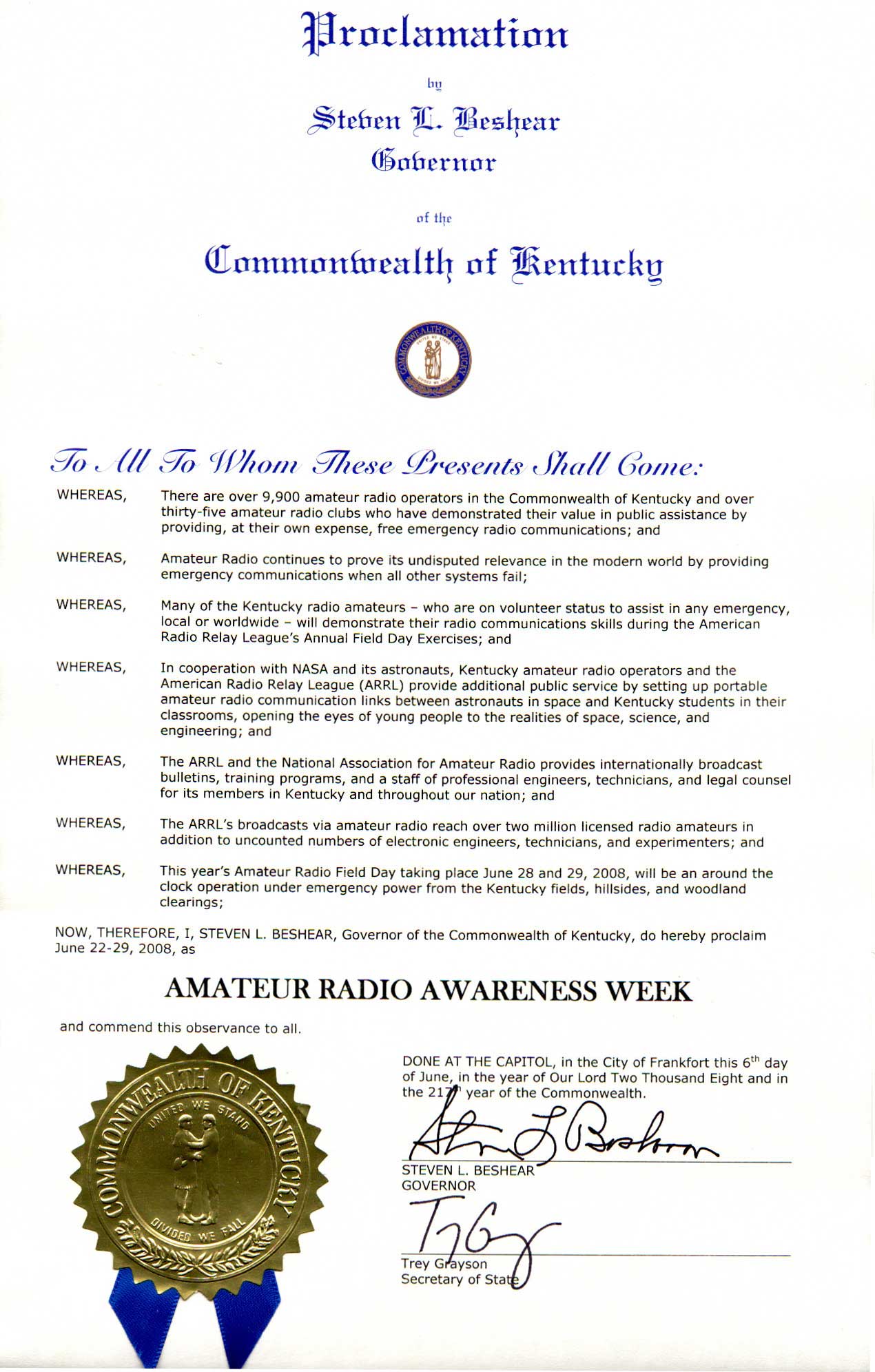
Gov Steve Beshear, Governor of Kentucky has proclaimed June 22nd-29th as Amateur Radio Week in Kentucky.

A copy of the proclamation can be found at this link here

Friday, June 20, 2008

CQD or SOS????

As a avid CW operator, I had always thought that SOS stood for 'Save Our Souls'

The BBC recently published an article outlining the history of CQ, CQD, and SOS.

In the early days of radio there was no voice communication. It was all morse code.

Before radio, ships in distress could only signal other ships in range using lights, flags or flares.

But before SOS the was a distress signal called CQD.

CQ was a general call to demand attention from all stations, preceding a time signal or other announcement. The Marconi company, the dominant power in early radio, suggested this signal be appended with a D to work as a distress signal.

Many people thought CQD meant 'Come Quick Danger' but in reality it did not mean anything except a distress call.

The year 1906 brought a wireless telegraphy conference in Berlin, and there was a pressure to agree on a common signal.

The Italians uses SSSDDD, the Germans used SOE, and everyone used CQD.

The conference decided to use SOS and set the effective date as July 1st, 1908.

Many mistakenly believed it stood for Save Our Souls, or Sinking Of Ship, or Send Out Succour or Save Our Ship.

The first ship believed to have sent an SOS was the American steamer Arapahoe in 1909.

When the Titanic was sinking in 1912, its operator first sent out CQD and then SOS, alternating.

So that is the story of the morse distress signal.

73, Jack K4SAC

Credit: BBC NEWS UK

Thursday, June 19, 2008

Sunspots

As most hams know, the solar cycle controls the amount of sunspots on the sun, which in turn affects the propagation here on Earth.

The solar cycle tends to run in 11 year cycles, where the maximum activity occurs in the middle of the sunspot cycle and the minimum occurs at the bottom of the 11 yr cycle as it transitions from one cycle to the next.

Unfortunately, there is not usually a sharp transition, the bottom may hang around for 2 years or more.

Solar activity is defined as sunspots, solar flares, or even solar eruptions(eruptions of gas from the Sun.)

The last cycle reached its peak in 2001 and is currently at the end of its cycle transitioning into the new cycle.

What has scientists that track solar cycles concerned is that this minimum has produced no solar activity at all. While some inactivity is normal, this period of inactivity has stretched longer than normal.

In the past there have been some extended periods of inactivity. There was a period in the past where the sun did not produce sunspots for 50 years, from 1650 to 1700.

This affect ham radio operators, because during the sunspot minima low bands such as 160, 80 and 40 become the workhorse bands because the propagation does not get up to the 20-10 bands as easily.

Some links that talk about propagation:

N0HR's propagation page

N3KL's propagation page

Solar Cycle 24 Page (Excellent site)

WM7D Solar Page

N6RT's Propagation page

And a link to propagation software


So those spots on the sun do affect us more than you know!

Credit: http://www.sciencedaily.com/releases/2008/06/080609124551.htm

73, Jack K4SAC


Blog List....

On the right of my blog, you can see that I am posting excerpts from other ham radio blogs around the blogosphere.

There are many ham radio blogs out here, so I can't post them all, but check out my blog list and links for other information.

K9JY has a good series running on Club Program Ideas, so those of you that are club officers, give his series a look!

73, Jack K4SAC

Wednesday, June 18, 2008

Field Day History

Field Day is coming upon us June 28th and June 29th and I thought I would write a bit about how Field Day began.

In 1933, The June 1933 QST announced that the second Saturday in June, for a period of 27 hours, starting at 4 pm local time, that hams would go into the "field" and set up portable stations.

W1BDI F.E. Handy said:
“The real object of this contest is to test ‘portables’ wherever they may be available.… If successful, we want to make it an annual affair.”

The scoring of that first contest was each QSO with fixed stations will count 1 point, contacts
with other portables count 2 points, and DX contacts count 3 points. Multiply QSO
points by the total number of ARRL sections, plus countries worked

September 1933 QST announced the winner of the 1st Annual Field Day was W4PAW. They made 62 QSOs and had 28 sections for a total of 1876 points.

1934 Field Day #2 is announced.

1936 Field Day was so popular that a second Field Day was held August 22nd-23rd of that year. The highest qso total for June was 143 and the highest QSo total for August was 136.

1937-Field day #5 is announced for June 19th-20th. The FD message bonus was added. The winning qso for this FD was 204 QSO's at a rate of 7.5 qsos/hr.

1938- Field Day period goes from 4 pm Saturday Local time to 6 pm Sunday Local time.

1939- the first rule to include all station apparatus must fall within a 100 ft radius excluding antennas.

1940-The 100' rules is changed to 500'. Home stations are allowed to work FD.

1941- The ARRL inadvertently forces a nationwide start time by notifying the FCC of the Field day period and the FCC communication 73-D references a single start time for all ham stations for Field Day from 4pm EST June 7th to 6pm EST June 8th.

1942-1945 All Ham activity ceases.

1946-Field day returns and adds a VHF only category

1948- 11 meters (now the CB band) is added for a Field Day Band. FD is shortened to 24 hrs. Battery and Emergency power categories are added.

1949- Mobile category added to FD.

1950- The modern day FD classes are established. The circle is increased to 1000'

1951- To encourage home emergency power, a home emergency power class is added Class D while home stations off power mains are class E.

1957- Simultaneous starts return, starts 4 pm EST and ends 4pm PST the next day. Anyone can operate 24 of the 27 operating period. 10,000th ham participates.

1963-ARRL rules that a FD site can only use one callsign.

1968- Setup within the 27 hr period is mandatory and the start time is moved to 1900z. All home stations are moved to Class D.

1969- The setup rule is hugely unpopular so ARRL changes the rule so that if you wait to set up you can operate the whole 27 hrs, otherwise you can only operate 24 hrs of the 27.

1970- A free Novice station is allowed. Starting time is moved to 1800z.

1972- Battery results are listed separately.

1973- Repeater rule is waived for satellite contacts and a 50 point sat bonus is included for the first time.

1974- A 100 point bonus is added for making contacts solely by natural power. 15 minutes rule for band changes is instituted.

1975- the Explosion of SSB leads the ARRL to institute a 2X multiplier for CW contacts.

1976- 10,000 qso mark is broken by W1VV/1

1977- The natural power bonus disappears and techs are now allowed to operate the Novice station. The 2X CW rule becomes permanent.

1980- RST is replaced with category and class for the exchange. Setup time is changed again, nothing can be set up before the 24 hr period. natural power comes back as a 100 point bonus. Sat and FD message bonuses increase to 100 points.

1981- Due to the popularity of packet radio, a 100 point bonus is instituted for one packet QSO and the repeater rules are waived for qso's through a digipeater. The Yankee Clipper Contest Club W2RQ turn in an impressive 11,201 qso total for Field Day.

1984- power multiplier is changed from 200 watts to anything less than 150 watts.

1993- Due to the influx of Technicians, a 100 point bonus is added for making 10 VHF/UHF contacts and a free VHF/UHF station is allowed class A and B.

1994- The modern FD record is set by K6CAB 15A by getting 3450 QRP QSO's for a total score of 30,150

1998- Free packet station and bonus are eliminated, but RTTY/PSK31 are added as a 3rd FD mode. The 100 point bonus for VHF/UHF stations is deleted.

So that is the history of Field Day. We've come a long way Baby!

Credit: December 1999 QST

Tuesday, June 17, 2008

Dayton Hamfest-The Future????

Inspired by a post on K9ZW's blog , He is having a discussion about the future of Dayton hamfest.

I was going to go to Dayton this year, but due to work issues at the last minute I was not able to attend.

Many of the posters on Steve's blog say that Hara Arena was in bad shape, that the Crowne Plaza (where many of the contesting and dx groups hold their hospitality rooms) was in bad shape.

Should the Dayton hamfest be moved to another city? Has Dayton had its heyday?

Vendors at Dayton this year reported an increase in sales much to everyone's surprise.

Tell me what you think and read Steve's blog as well.

73, Jack K4SAC

Powered by Blogger